
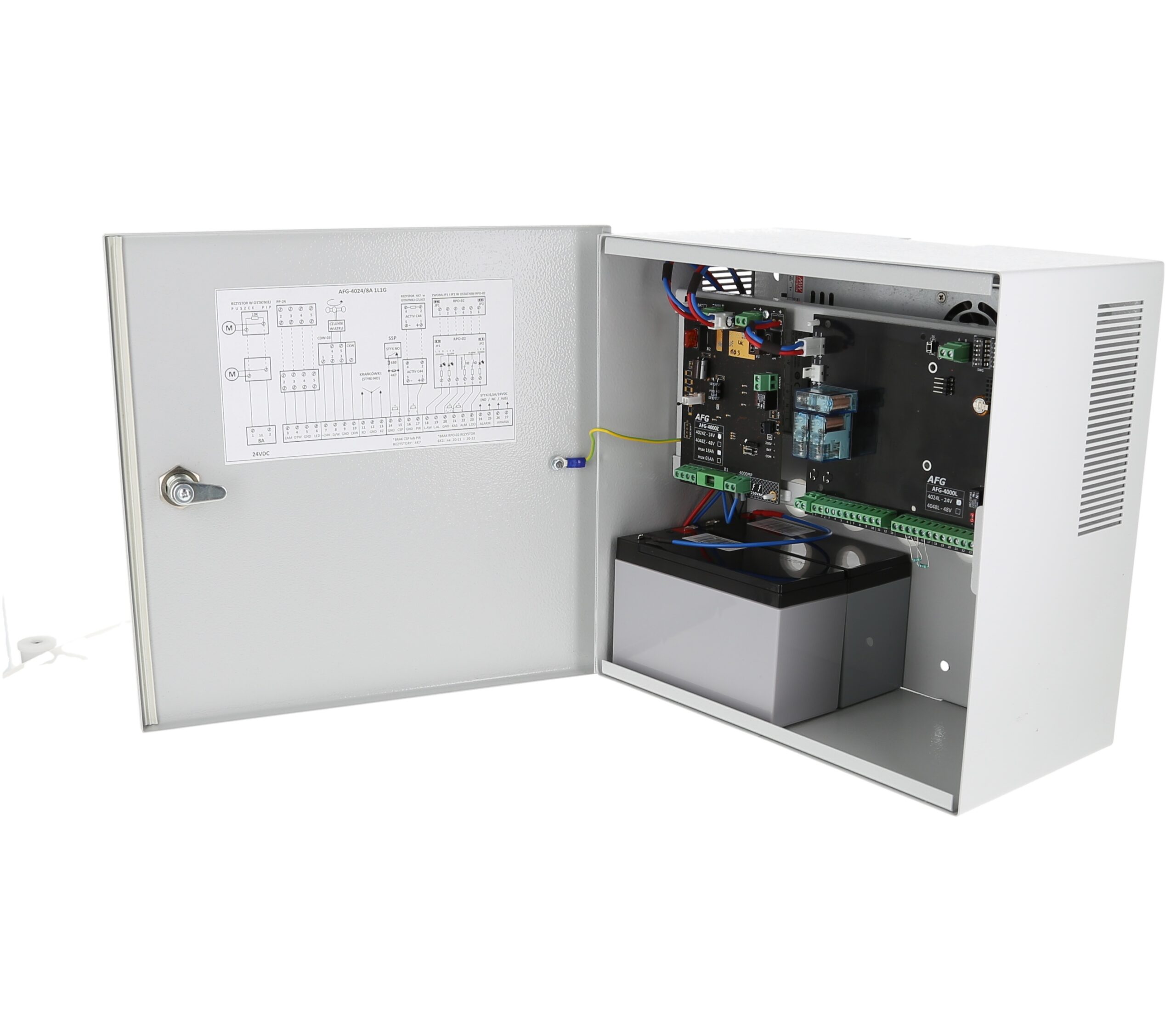
AFG-4024 Smoke Ventilation And Daily Ventilation Control Unit
The AFG-4024 from the AFG-4000 series is an autonomous smoke ventilation and daily ventilation control panel designed to control and power 24 V DC actuators used in smoke vents, smoke exhaust windows, air inlet doors, smoke curtains, pneumatic vent release systems and selected intermediate control elements such as contactors or fan inverters. This English version follows the exact version logic and system structure presented on the Polish reference page.
Table Of Contents
- System Characteristics And Control Functions
- Modular Design And Version Marking
- Technical Parameters And Formal Basis Of Use
- Inputs, Outputs And System Logic
- How To Select The Correct AFG-4024 Version
- Exact Version Marking Used For AFG-4024
- Configuration, Networking And Integration
System Characteristics And Control Functions
The AFG-4024 smoke ventilation control unit is an autonomous element of a smoke exhaust and natural ventilation system. It controls and supplies 24 V DC power to devices such as smoke vent actuators, smoke exhaust window drives, air inlet door drives, smoke curtain drives, electromagnetic triggers for pneumatic vents, and control signals for intermediate devices including contactors and fan inverters.
The manufacturer defines three principal operating paths: fire smoke extraction, daily ventilation and automatic closing in bad weather conditions. Smoke extraction can be triggered by a smoke detector, a temperature detector, a manual smoke vent button, or an external signal, for example from a fire alarm system. Daily ventilation is triggered from a ventilation button, while automatic closing during rain and strong wind is handled by a weather sensor.
Operating priorities are clearly defined. Fire smoke extraction has the highest priority, the weather signal has lower priority, and daily ventilation has the lowest priority. Any higher-priority function blocks the lower-priority one. In standard actuator mode, control is performed by polarity reversal on the actuator output, which determines the movement direction of the connected actuators.
The system supervises opening and closing limit switches, which stop the control process and confirm end positions. The maximum opening time is monitored and set to 60 seconds. If this time is exceeded, the unit reports a fault locally and through the common fault output. The documentation also describes a forcing procedure in case of a blocked vent: after the 60-second limit is exceeded, the unit makes a short reverse movement and then attempts to reopen again, repeating the cycle for up to 30 minutes if limit switches are used.
Modular Design And Version Marking
The AFG-4024 has a modular architecture. The basic configuration is the AFG-4000L line module working as the MASTER module, controlling one smoke extraction line and one daily ventilation group. It provides connections for manual smoke vent buttons, smoke detectors and the fire alarm control panel input. Expansion is achieved by adding extra modules for additional ventilation groups, relay outputs and communication functions.
| Module | Function | Practical Use |
|---|---|---|
| AFG-4000L | Smoke extraction line module and 1 ventilation group | Basic MASTER module, support for RPO, smoke detectors, FACP input, ventilation button, weather sensor and wind direction sensor |
| AFG-4000G | Additional ventilation group module | Extension with another actuator output for daily ventilation |
| AFG-4000P | Relay module | Additional control for fans, smoke curtains, fire compartment devices or door holders |
| AFG-4000K | Communication module | Integration with visualisation systems, BMS, SCADA and panel networking |
| AFG-4000Z / AFG-ZSP | Power supply and battery supervision | Main and emergency power supply depending on panel version |
Modules are connected through an RS485 bus with the manufacturer’s protocol. The documentation describes an addressable network of up to 31 modules on the bus. For ring topology networking of complete control panels with the communication module, the limits given are up to 16 panels and up to 200 m between devices.
The type code carries direct installation information. AFG-4024 indicates a 24 V DC version for actuators. The value after the slash defines the current capacity, followed by the number of L lines and G groups. Additional suffixes are used as follows: +P for an integrated relay module, +K for a communication module and FLM for the variant with an interface to the LSNi detector loop.
Technical Parameters And Formal Basis Of Use
For the AFG-4024, the key operating parameters include 230 V AC 50 Hz supply voltage with a tolerance of -15% / +10%, a working voltage of 20.5–28.5 V DC and current capacity in the range of 4 A to 80 A depending on the version. The enclosure protection rating is IP30, the environmental class is I, and the working temperature range is -10°C to +55°C.
From an integrator’s point of view, line supervision is particularly important. For the AFG-4000L line module, the documentation specifies 3 supervised lines, a limit of 15 devices per detection line, detector line voltage of 20.5–28.5 V DC and permissible line resistance up to 500 Ω. The technical tables also show maximum 230 V AC current draw depending on the panel version, for example from 0.8 A for the 4 A version up to 11.0 A for the 80 A version.
Buffered power supply voltage is given as 27.2 V ±0.2 V DC, and depending on the specific panel type, the documentation allows battery capacities up to 64 Ah in special versions. The power supply documentation indicates compliance with EN 12101-10:2005+AC:2007 and EN 54-4:1997+AC:1999+A1:2002+A2:2006.
From the formal approval point of view, the Polish documentation also references CNBOP-PIB approvals for AFG-4024, AFG-4048 and AFG-ZSP-4024, as well as a national constancy of performance certificate based on CNBOP-PIB-KOT-2022/0325-1009 issue 2. The manufacturer named in the approval documents is AFG Elektronika Przemysłowa Maciej Garczarek, Poznań.
Inputs, Outputs And System Logic
In the AFG-4000L line module, the terminal mapping is prepared for a typical smoke ventilation architecture: actuator output on terminals 1–2, ventilation button inputs on 3–6, weather sensor and wind direction sensor inputs on 7–10, opening and closing limit switch inputs on 11–13, fire alarm panel input on 14–15, smoke detector input on 16–17, manual smoke vent button connections on 18–23, common ALARM and FAULT outputs on 24–27, plus RS485 and extension module power connections.
For integration with a superior system such as an FACP, the documentation describes a VdS standard for supervised inputs: signal range of 8–30 V, neutral state with 4.7 kΩ resistance and active state at 590 Ω. Values substantially lower or higher are treated as faults. End-of-line resistors must be installed at the contact side, and potential-free contacts operate in active-short logic.
The common ALARM and FAULT outputs are relay outputs. The line module allows configuration using jumpers J1–J4 for NC, NO and VdS mode with 3.3 kΩ resistance for normal no-alarm/no-fault state and 560 Ω for alarm or fault indication. This is critical when integrating with fire alarm panels that require supervised input status, so the configuration should always be agreed with the FACP/BMS integration documentation.
The RPO-02 manual smoke vent button is a supervised element. Up to 15 units may be connected, and the last button in the line must be fitted with an end-of-line jumper. The button provides alarm triggering, alarm reset and LED status indication. Double reset activation additionally triggers emergency closing of all vents in the line as a retraction function for actuators. Loss of communication with an RPO unit is immediately reported as a fault.
For daily ventilation, the manufacturer describes several versions of PP ventilation buttons. Daily ventilation has the lowest priority and is active only when mains power is present, in order to limit battery discharge. A single ventilation opening command starts a timed pulse operation, the duration of which is set using the SW2 switch.
| Terminals | Function | Installation Notes |
|---|---|---|
| 1–2 | Actuator output | 24 V DC actuator control output |
| 3–6 | Ventilation button block | Close, Open, GND, LED |
| 7–10 | Weather sensor / wind direction sensor | 24 V DC supply and supervised signal inputs |
| 11–13 | Open / Close limit switches | Position confirmation and closed vent signal |
| 14–17 | FACP and smoke detector inputs | Alarm inputs for fire alarm and smoke detector circuits |
| 18–23 | RPO-02 manual smoke vent button | Fault, Trigger, GND, Reset, Trigger, Supervision |
| 24–27 | Common ALARM / FAULT outputs | Potential-free contacts for FACP, BMS or monitoring |
How To Select The Correct AFG-4024 Version
Selection of the AFG-4024 version should be made along three main axes: required number of smoke extraction lines, required number of daily ventilation groups and required actuator current capacity. In the manufacturer’s nomenclature, a line corresponds to fire smoke extraction logic, while a group corresponds to daily ventilation logic. This directly determines how many AFG-4000L and AFG-4000G modules are required.
The +P version is especially important where, beyond actuator control itself, independent control of external devices is required, such as fans, smoke curtains, fire separation devices or door holders. The relay module provides two changeover relays P1 and P2 with contact load of 230 V AC / 8 A, with the option to power the contacts from an external source or from the internal 24 V DC / 1 A supply. The module also supports timing settings, confirmation inputs and K1–K4 supervision logic.
Exact Version Marking Used For AFG-4024
The version structure shown on the reference page is translated below exactly into English notation. This is the version logic that should be preserved when creating the English product page.
| Marking Element | Meaning |
|---|---|
| AFG-4024 | 24 V DC smoke ventilation control unit for actuators |
| 4A / 8A / 16A / 24A / 32A / 40A / 48A / 56A / 64A / 72A / 80A | Current capacity of the selected version |
| 1L | 1 smoke extraction line |
| 2L / 3L / 4L / 5L / 6L / 7L / 8L / 9L / 10L | Number of independent smoke extraction lines |
| 1G / 2G / 3G / 4G / 5G / 6G / 7G / 8G / 9G / 10G | Number of daily ventilation groups |
| +P | Additional relay module |
| +K | Communication module |
| FLM | Version with LSNi detector loop interface |
Practical note: in this product family, a line corresponds to the fire alarm smoke extraction function, while a group corresponds to the daily ventilation function. That distinction is essential when interpreting designations such as 1L2G, 2L2G or 4L4G.
Configuration, Networking And Integration
Configuration of the actuator output mode on terminals 1–2 is performed using the SW1 switch. The documentation defines the following modes: NORMAL (polarity reversal, alarm opening), ZE (pulse control of an electromagnetic trigger), WEN (constant polarity in alarm mode for devices such as contactors or inverters), and REVERSED (polarity reversal, alarm closing).
The same configuration block also provides additional functions, including smoke detector confirmation logic, automatic vent closing after time delay, operation with limit switches and support for an additional ventilation group. The SW2 switch is used to set timing and bus logic parameters, including actuator output delay, opening time in daily ventilation mode, activation of additional inputs, actuator line control and MASTER/SLAVE role on the internal RS485 bus depending on whether the module is used as a line or group module.
This makes the AFG-4024 suitable not only as a standalone smoke ventilation panel, but also as part of a broader integrated fire safety and building control system involving FACP, BMS, visualisation, relay-controlled external devices and supervised weather-dependent automation.