
What are make-up air doors in a smoke exhaust system?
What are make-up air doors in a smoke exhaust system? Make-up air doors are doors that open automatically during a fire alarm and create an air inlet opening supplying air to the space protected by a smoke and heat exhaust ventilation system. This most commonly applies to staircases, lobbies or escape routes fitted with natural…
What are make-up air doors in a smoke exhaust system?
Make-up air doors are doors that open automatically during a fire alarm and create an air inlet opening supplying air to the space protected by a smoke and heat exhaust ventilation system.
This most commonly applies to staircases, lobbies or escape routes fitted with natural smoke and heat exhaust ventilation. Their function is not to extract smoke. Smoke and hot gases are discharged through a smoke vent, smoke exhaust window or another exhaust device located in the upper part of the protected space.
Make-up air doors provide low-level replacement air so that the system can operate in accordance with the fire strategy.
Make-up air doors do not replace a smoke vent. They supply the air required to support the effective flow of smoke and hot gases towards the smoke exhaust device.
Why is air supply so important?
Natural smoke and heat exhaust ventilation operates correctly only when air can enter the building and smoke can be discharged to the outside. If only the smoke vent opens and no suitable make-up air opening is created, the airflow may be restricted.
In practice, this means lower smoke extraction efficiency, slower clearing of the escape route and a higher risk of issues during the State Fire Service acceptance inspection. In a staircase, air should be supplied at low level, while smoke should be discharged as high as possible. This arrangement supports the natural buoyancy-driven movement of hot fire gases.
Can any door be used as a make-up air door?
No. The door must be assessed in terms of its function, location, opening direction, dimensions, leaf weight, hardware, locking method and impact on evacuation. Simply installing an actuator is not enough to make a door a compliant component of a smoke and heat exhaust ventilation system.
The design must define whether the required make-up air area is achieved after opening. It is not only the width and height of the opening that matter, but also the actual door leaf opening angle, door closer, lock, electric strike, door stops, pull handles and all other components that may reduce the effective air inlet cross-section.
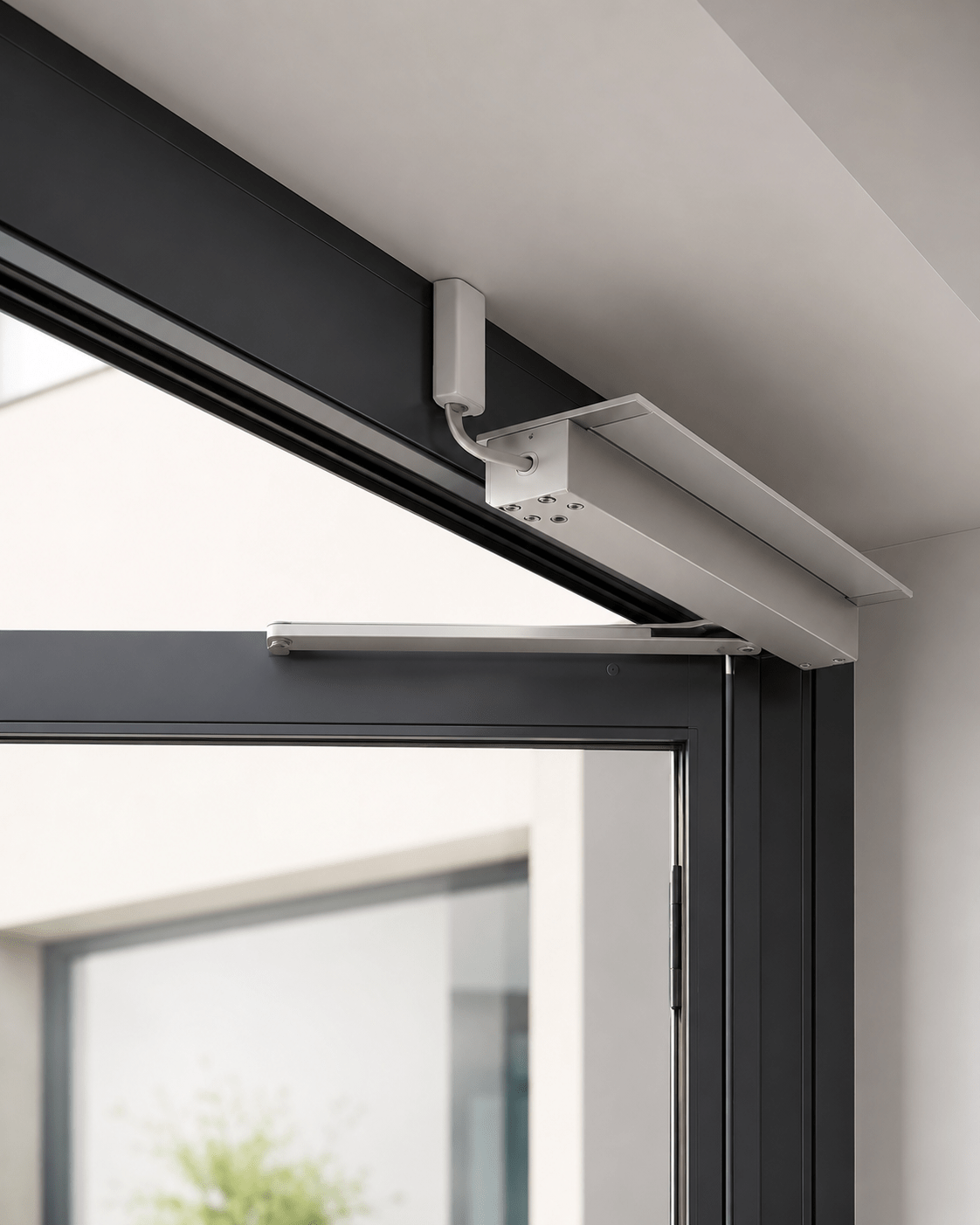
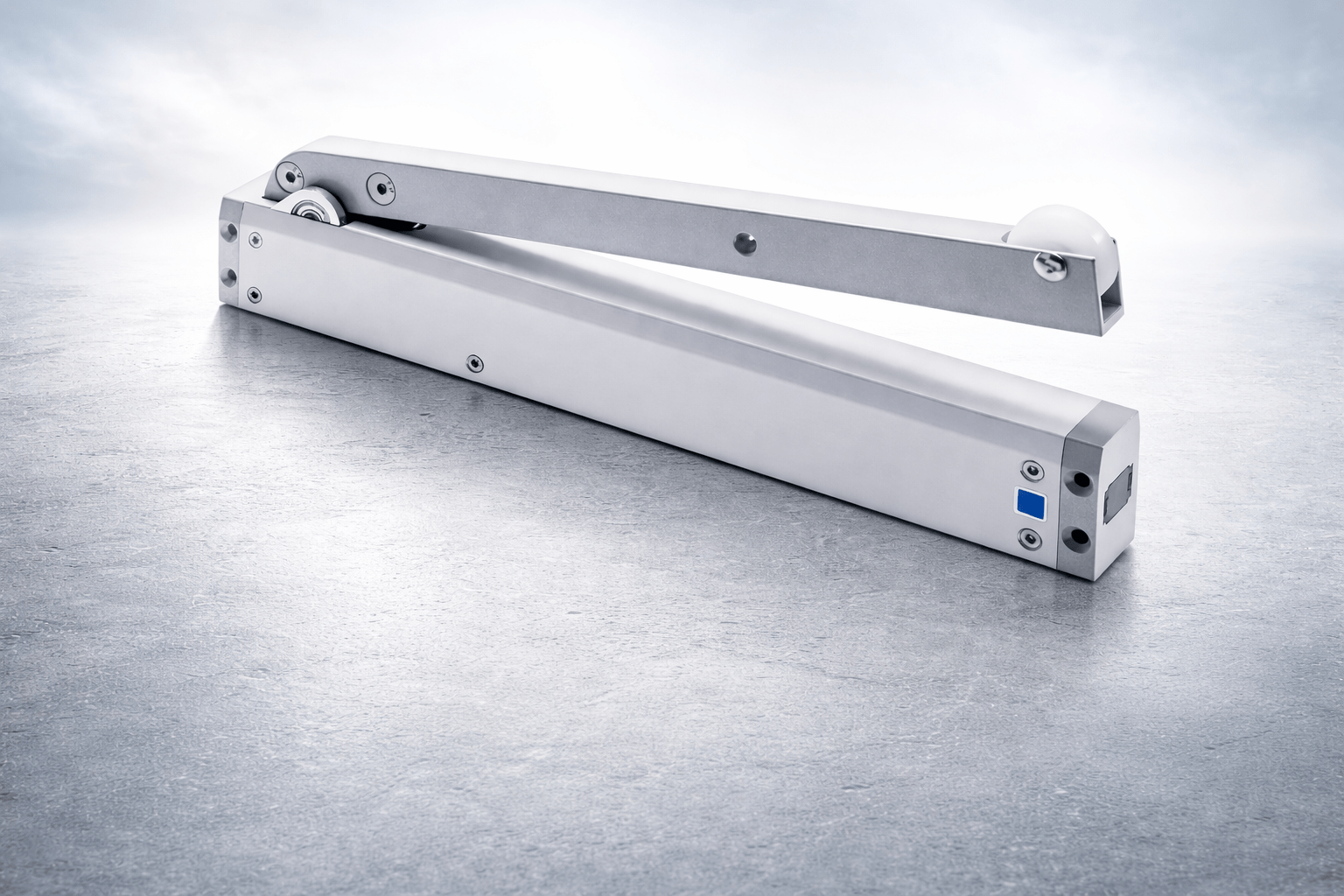
FTA600 R as an actuator for make-up air doors
FTA600 R S12 24 V DC is an arm actuator intended, among other applications, for opening make-up air doors in smoke and heat exhaust ventilation systems and natural ventilation systems. It operates at 24 V DC, so it can be supplied from a smoke control panel with primary and standby power supply.
In a typical configuration, the actuator opens the door leaf to an angle of approximately 90 degrees. However, selection must take into account the door leaf weight, hinge resistance, door closer, seals, frame profile, installation position and absence of collisions during door leaf movement.
View the FTA 600 R product pageThe role of the electric strike and opening sequence
A common error is assuming that a door actuator will cope with any closed door leaf. It will not, if the door remains locked. In a smoke and heat exhaust ventilation system, the door must be released before the actuator starts moving.
FTA600 R has a programmable volt-free contact for controlling an electric strike or another release device. In practice, this allows the following sequence to be implemented: first the lock is released, then the door leaf starts opening. This is important during acceptance inspection, because the system should operate repeatedly, without jerking, blocking or overloading the actuator.
Doors and the escape route
Doors used as make-up air doors are often located on routes used by building occupants. Their automatic opening must not reduce evacuation safety. It is necessary to check whether, after opening, the door leaf narrows the passage, blocks another exit or collides with a handrail, hydrant, pull handle or fixed equipment.
Fire-rated doors
If the door forms part of a partition with a required fire resistance or smoke control rating, any interference with the door leaf, frame, hardware or locking arrangement must be assessed carefully. The actuator should not be treated as a neutral accessory installed without any impact on the declared performance of the door.
How does the system operate during a fire alarm?
After fire detection, the smoke control panel activates the devices in accordance with the fire strategy. In a natural smoke and heat exhaust ventilation system, a smoke vent or smoke exhaust window in the upper part of the staircase is usually opened, while make-up air doors at the lower level are opened at the same time.
The signal may come from smoke detectors, a smoke control manual switch, the fire alarm system or another device specified in the design. During a fire alarm, the fire safety function takes priority over comfort functions. A weather sensor, daily ventilation switch or local control must not prevent the doors from opening in fire mode.
What does the State Fire Service check during acceptance inspection?
During acceptance inspection, it is not enough to verify whether the actuator physically opens the door. The operating logic of the entire system is checked. The doors should open after the alarm signal, reach the required position, not obstruct evacuation and operate correctly with the remaining smoke and heat exhaust ventilation components.
Most common errors with make-up air doors
How to avoid issues during State Fire Service acceptance inspection?
The safest approach is to start with verification of the design and fire strategy, and only then select the actuator. It is necessary to determine the required make-up air area, door location, opening direction, required opening angle, door leaf release method and dependencies between the smoke control panel and other systems.
- Check whether the door leaf moves smoothly, without rubbing or excessive resistance.
- Verify the actuator installation position, bracket, arm position and absence of collisions.
- Check that the electric strike releases before the actuator starts.
- Perform an opening test from fire alarm, using both primary and standby power supply.
- Confirm that the as-built condition corresponds to the design documentation.
For FTA600 R, the correct installation position, bracket selection, required clearance on the frame and door leaf, and verification that the roller and arm operate without jamming are particularly important. A mechanical error usually cannot be corrected by programming the control panel.
Can the doors be used for daily ventilation?
Yes, provided this is included in the design and control logic. However, the comfort function must be separated from the fire safety function. In everyday operation, the user may use the system for ventilation, but in alarm condition the system must operate automatically and with priority.
What should the user know?
The user should know that make-up air doors are part of the fire safety system. They must not be blocked, disabled, obstructed by equipment or modified by changing hardware without verifying the impact on system operation.
Perform a functional test after every modification
This also applies to apparently minor works, such as replacing an electric strike, adjusting a door closer, installing an additional bolt, changing the access control system or carrying out works on the smoke control panel. If the door mechanics or control logic changes, it must be confirmed that the door still opens in accordance with the fire strategy.
Summary
Make-up air doors are one of the key components of a natural smoke and heat exhaust ventilation system. They supply make-up air that enables effective flow of smoke and hot gases towards the smoke exhaust device. Without correct make-up air supply, even a properly selected smoke vent may fail to operate as intended.
FTA600 R is an example of an arm actuator intended for automatic opening of make-up air doors. Its effectiveness depends not only on the device parameters, but also on the design, door mechanics, lock release, power supply, control logic and final functional tests.
Go to the FTA 600 R product pageDownloads
Technical and formal documents for FTA actuators, including FTA 600 R, useful for design, acceptance inspections and preparation of as-built documentation.